About Reynolds Apparatus
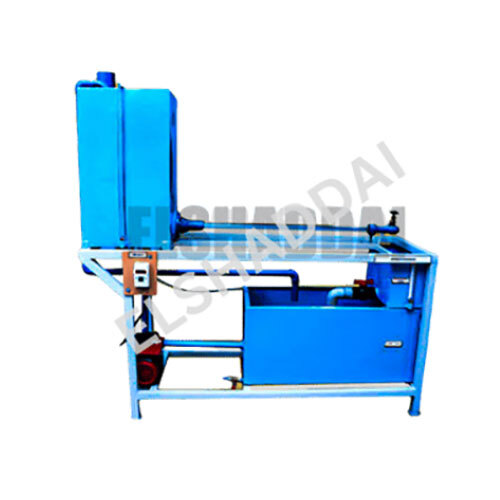
This set up is designed to verify Reynoldss Apparatus experimentally. The Apparatus consists of a glass tube with one end having bell mouth entrance connected to a water tank. At the other end of the glass tube a cock is provided to vary the rate of flow. Flow rate of water can be measured with the help of Measuring Cylinder and Stop Watch supplied with the set-up. A capillary tube is introduced centrally in the bell mouth. To this tube dye is fed from a small container, placed at the top of Constant head Tank, through polythene tubingFlow Visualization Made SimpleThe integrated dye injection system and clear borosilicate glass tube allow users to easily observe and differentiate between laminar, transitional, and turbulent flow patterns within the apparatus. This promotes deeper understanding of fluid dynamics for students and professionals alike.
User-Friendly Design and ControlEquipped with manual valve controls and analog scales, this Reynolds Apparatus offers straightforward operation. Its benchtop installation, 30-liter capacity, and durable mild steel construction enable easy handling and reliable use in labs or classrooms.
Precision and DurabilityEngineered for accuracy, the apparatus utilizes high-grade materials and offers excellent corrosion and temperature resistance (up to 80C). Backed by a one-year warranty, it stands as a dependable solution for flow visualization experiments and demonstrations.
FAQ's of Reynolds Apparatus:
Q: How does the dye injection system enhance flow visualization in this apparatus?
A: The integrated dye injection system introduces a visible tracer into the water stream, making it possible to observe and distinguish the different flow regimes-laminar, transitional, and turbulent-within the borosilicate glass tube during experiments.
Q: What is the primary application of the Reynolds Apparatus?
A: This apparatus is designed to demonstrate the transition from laminar to turbulent flow in a pipe, aiding in the study and understanding of fluid mechanics principles in educational and research settings.
Q: When should I use the Reynolds Apparatus in a laboratory setting?
A: Use the apparatus when you need to visually demonstrate or investigate fluid flow characteristics, especially when illustrating how flow type changes with varying velocity in pipes during hydraulics and fluid mechanics courses.
Q: Where can this apparatus be installed or placed for use?
A: The Reynolds Apparatus is intended for benchtop installation, making it suitable for use in laboratories, classrooms, or research facilities where space is limited and mobility is an asset.
Q: What is the process of conducting an experiment using this equipment?
A: To use the apparatus, fill the tank with water, set up the power supply, adjust the manual valve to control flow rates, inject dye for visibility, and observe the nature of flow through the glass tube using the graduated scale for precise measurements.
Q: What benefits does this apparatus offer for teaching and research?
A: The apparatus provides highly accurate and immediate visual feedback on flow patterns, enhancing the learning experience. Its durable construction, clear graduation, and precise control contribute to reliable repeated experiments and demonstrations.
Q: How do I maintain the Reynolds Apparatus and ensure longevity?
A: Regularly clean the glass tube and measuring tank, ensure the pump is free from obstructions, avoid exceeding the 80C temperature limit, and check the mild steel base for signs of corrosion. Proper maintenance ensures consistent performance and durability.

 Send Inquiry




 Send Inquiry

 Send Inquiry