About Microchannel Heat Exchanger setup
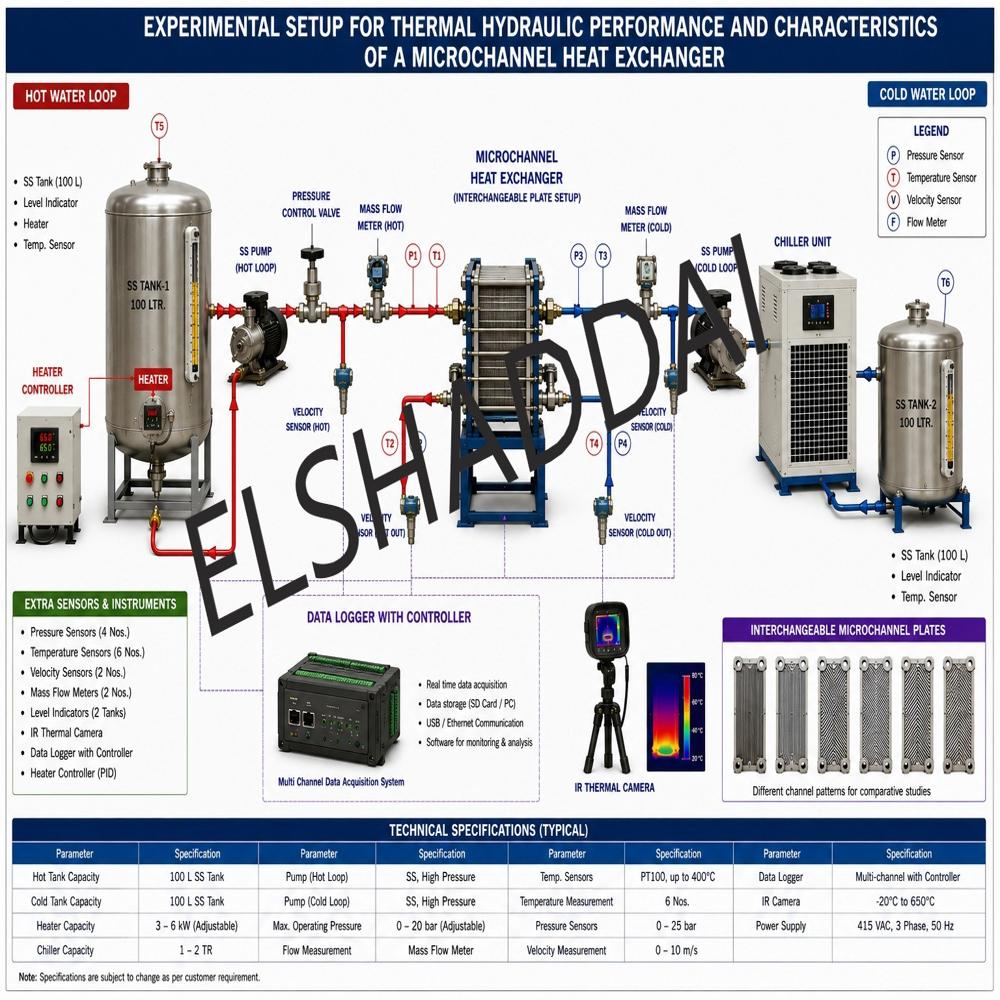
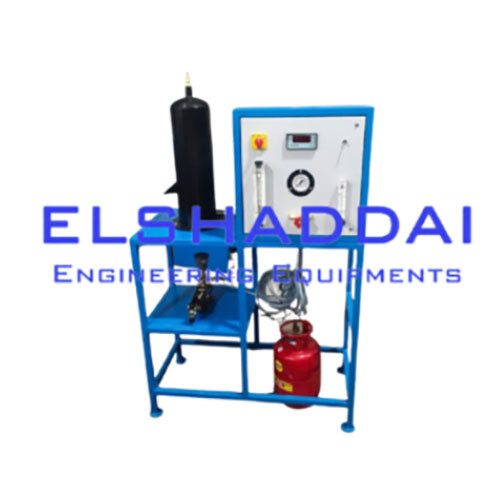
The Microchannel Heat Exchanger Setup is a modern laboratory training system designed to demonstrate the construction, operation, and performance characteristics of microchannel heat exchangers used in refrigeration, air conditioning, automotive, and industrial cooling applications. The setup enables students to study heat transfer efficiency, pressure drop, and overall thermal performance under different operating conditions.
The trainer consists of a compact microchannel heat exchanger integrated with pumps, flow control valves, temperature sensors, pressure gauges, and a digital measuring system. It allows users to vary flow rates and monitor inlet/outlet temperatures to evaluate heat transfer effectiveness and compare the performance with conventional heat exchangers.
1. Hot Water Storage Tank with Integrated Heater
2. Cold Water Storage Tank
3. Chiller Unit
4. Hot Water Circulation Pump
5. Cold Water Circulation Pump
6. Pressure Control System
7. Microchannel Heat Exchanger (Test Section)
8. Flow Sensors
9. Pressure Sensors
10. Temperature Sensors
11. Heat Flux Sensor
12. Temperature Indicator
13. Infrared Thermal Imaging Camera
14. Industrial Data Acquisition System (Data Logger)
15. Experimental Monitoring & Analysis Software
16. Electrical Control Panel
17. Supporting Structure / Test Bench
18. Computer System (Customer Scope)
Stainless Steel ConstructionBuilt entirely from premium stainless steel, this microchannel heat exchanger resists corrosion and provides enduring strength under laboratory conditions. The material choice guarantees hygienic and contamination-free operation, especially important for sensitive experiments.
Precision Engineered DimensionsWith measurements of 3 meters in length, width, and height, the system offers ample space for efficient thermal exchange and ease of access during experimental operations. This design enhances process control and safety during laboratory use.
Reliable Power and PerformanceRunning on a conventional 220V power supply and utilizing advanced power electronics, the heat exchanger ensures consistent and efficient heating or cooling. Its high power handling capacity makes it suitable for various laboratory testing scenarios.
FAQ's of Microchannel Heat Exchanger setup:
Q: How is the microchannel heat exchanger setup installed in a laboratory environment?
A: Installation involves positioning the 3x3x3 meter unit on a level surface with proper clearance for maintenance. It requires a standard 220V power connection and connection to relevant fluid circuits. Following the manufacturer's guidelines ensures safe and efficient operation.
Q: What materials are used in the construction of this heat exchanger setup?
A: This microchannel heat exchanger is constructed from high-quality stainless steel (SS), ensuring durability, corrosion resistance, and suitability for demanding laboratory and research applications.
Q: When should this microchannel heat exchanger be used in laboratory processes?
A: It is ideal for use during thermal transfer experiments, fluid dynamics research, or any process requiring precise temperature control and high efficiency in laboratory environments.
Q: Where can this setup be employed outside of laboratories?
A: Though designed primarily for laboratories, this unit can also be used in research centers, quality control departments, and pilot plants, provided the operational space and power requirements are met.
Q: What is the process for operating the microchannel heat exchanger setup?
A: Operation involves connecting the heat exchanger to input and output fluid lines, setting desired flow rates and temperatures, and activating the unit via its control system. Continuous monitoring ensures optimal performance and safety.
Q: How does the microchannel design benefit laboratory users?
A: The microchannel configuration enhances heat transfer efficiency by increasing surface area and enabling rapid temperature adjustment, which is crucial for accurate and repeatable laboratory results.
Q: What maintenance is required to keep the heat exchanger in optimal condition?
A: Routine inspections should be performed to check for blockages, corrosion, or leakage. Regular cleaning of the channels and verification of electrical connections help ensure long-term reliability and performance.

 Send Inquiry



 Send Inquiry

 Send Inquiry